Home › Solutions

Plan. Predict. Execute. Optimise.

Four areas of supply chain operations, on one operating record. Below them, the two applications running today — everything listed there is something the code already does.

Plan

Supply planning

Demand, supply and capacity planned against the constraints that actually bind, rather than against an average.

Predict

AI-based decisions

Decided from the operating record of the site itself, not an industry benchmark. Risk scored before the shift that would feel it.

Execute

Logistics execution

Inbound and outbound run end to end. Assignment and sequencing decided and committed, not suggested.

Optimise

End-to-end visibility

One operational view across carriers, suppliers, warehouses, transport systems and ERP, auditable by construction.

Running today · 01

A conversational chatbot for logistics

Ask a question about the operation in plain language and get an answer out of live data, rather than a dashboard you have to interpret yourself. It runs the query, does the work, and shows what it did.

ASK THE OPERATION idle
PARSE
QUERY
GROUND
ANSWER

ASK

plain language→query 0 rows every step shown

EXAMPLE QUESTIONS · THE SHAPE IS WHAT THE APP DOES
what it does
  • Questions in plain language, answered against the operational data warehouse
  • Every step shown — the query it ran, what came back, how long it took
  • Writes proof-of-delivery events back into the transport management system

NATIVE iOS · WEB CLIENT ON THE SAME API

what it refuses
  • A dry-run interlock: the message is generated and shown but never transmitted until that is switched off deliberately
  • Sign-in held in the Keychain, optionally behind Face ID
  • New accounts stay pending until an administrator approves them

distributed to testers — not on the App Store
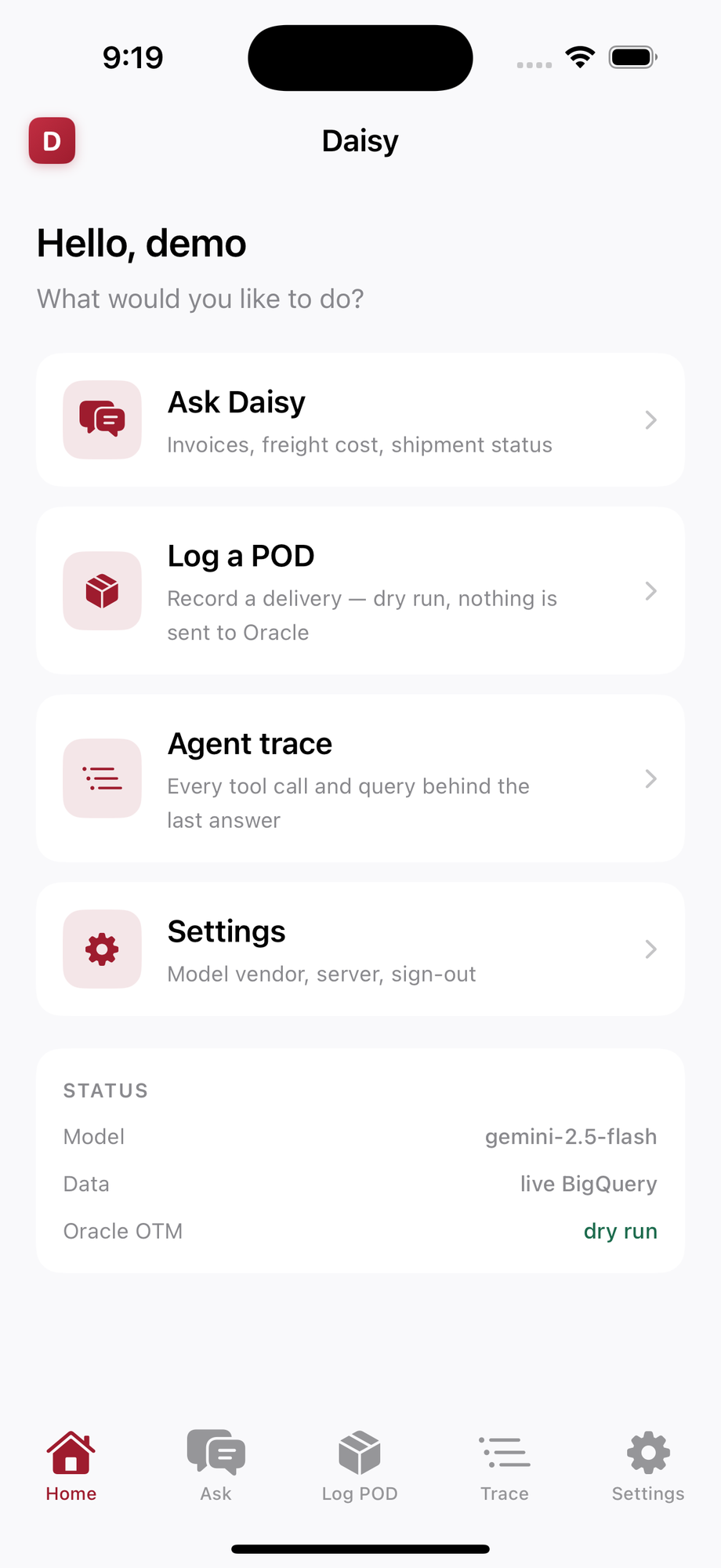
The chatbot on iOS, showing an answer and the tool calls behind it.
In testingAsk it something, log a delivery, or read back every tool call behind the last answer.

Running today · 02

Dock and yard management

A driver reaches a distribution centre and holds up the QR code from their booking. The gate keeper scans it on the gate’s own device and reads back a door number. Everything after that hangs off the same record.

at the gate
  • Check-in by QR code — no app and no account for the driver
  • Door assignment against the load: a chilled trailer only ever gets a powered door
  • Gate and departure inspections, where a critical defect refuses entry and gives the door back

iPHONE, iPAD AND WEB

on the yard
  • Named standing spots and GPS zones
  • Weighbridge reconciliation and certificate-of-analysis conformance for bulk
  • Four roles — driver, security, warehouse, carrier — each seeing only their own work

running against a live database

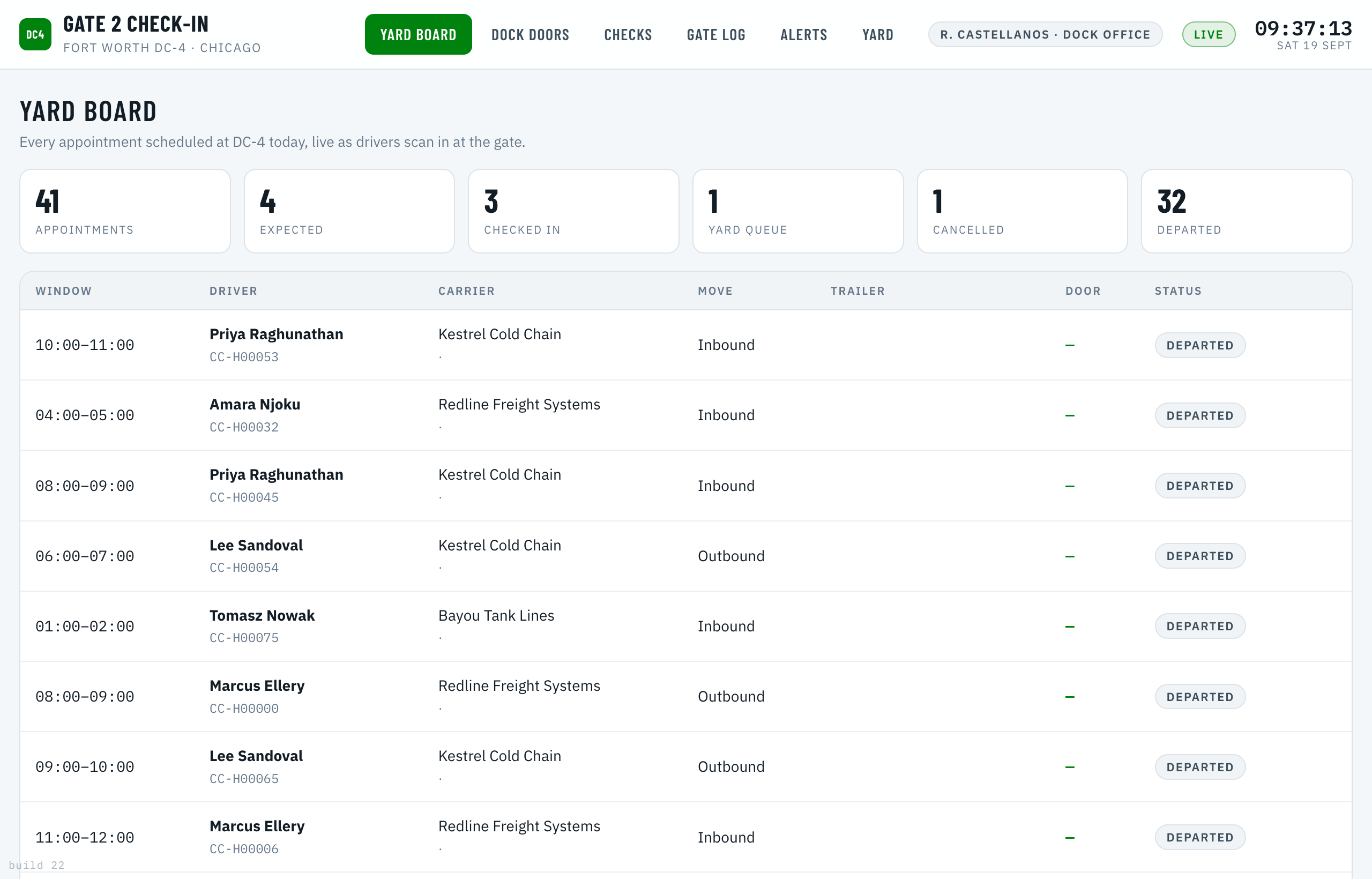
The dock office board, showing every appointment for the day as drivers scan in.
In testingThe same site from the dock office — every appointment for the day, live as drivers scan in at the gate.

Open to anyone. Both applications are built by one pair of hands. What is on this page is what the code does today; anything else we will name as a plan rather than let you assume it.

Know this problem? Build it with us.

If you run a gate, a yard or a planning desk, you know things about this problem that we do not. If you write software, there is a great deal here worth building.

Get in touch